


This article was written for Flying Snake – a Journal of Cryptozoology, Folklore and Forteana, November 2025.

I’VE BEEN monitoring big cat sightings in the county of Suffolk for the past 10 years now.
I self-published Mystery Animals of Suffolk – including an account of over 150 mystery big cat sightings in 2023 I and launched bigcatsofsuffolk.com soon afterwards – a site for reporting big cat sightings in East Anglia.
In my most recent count in February this year (2025) I had logged a total of 228 big cat sightings in the county of Suffolk or within a few miles of its boundaries, going back to the first account of a sighting in 1976 or 1977 in Rendlesham Forest, up to the most recent sighting a couple of weeks ago. While things have calmed down a bit now, at its busiest bigcatsofsuffolk.com was getting a couple of reports a week of big cat sightings. (See the “report a big cat in Suffolk” form.)
I have found that sightings are more frequent in the autumn and winter – there are fewer people around in these months, which the big cats seem to prefer, while in the summer the dense foliage and the abundance of wildlife means the big cats don’t have to show themselves as much as they do in the winter when there is less cover and less to eat.
Suffolk in the East of England is a mostly rural county, with fewer than 700,000 human inhabitants, there are some parts of the county such as the area around Blythburgh, famous for Blythburgh free range pork sold in posh butchers nationwide, where there are said to be “more pigs than people.” The sandy acidic soil by the Suffolk coast makes the county the perfect place to grow barley. Suffolk has numerous nature reserves and is home to England’s biggest lowland forest – Thetford Forest, as well as the equally impressive Rendlesham Forest, the King’s Forest nearby and also Dunwich Forest where I am based. There are plenty of places in Suffolk for big cats to hide! There are a lot of wetlands and heaths along the Suffolk coast and its estuaries which are high in biodiversity and would be ideal big cat country.
The county also has a problem of overpopulation by deer. Despite the best efforts by licenced deerstalkers and regular Forestry Commission and Natural England deer culls, the herds of red deer, fallow deer, muntjac deer and over the past two decades the more recently self-introduced Chinese Water Deer are now so huge they are in danger of damaging some of the county’s natural habitats. A warden on one of the RSPB reserves in Suffolk told me that herds of 200 or more red deer are not uncommon. There are also sika deer just over the border in Norfolk and deerstalkers I have talked to say it’s only a matter of time before this species of deer turn up in Suffolk too.
I’ve heard reports of Suffolk big cats running after deer – in Bures (in South Suffolk, right on the Essex border) and in Rushbrooke (just outside Bury St Edmunds), where a big cat was seen “chasing a small deer.”
So big cats follow the deer, and it’s no coincidence that many of the hotspots for big cat activity in the county, areas where sightings of big cats occur frequently, are around the river valleys. Deer need to come down to the rivers to drink, so it makes sense for big cats to frequent the areas around the rivers. Environmental regulations restricting intensive agriculture around rivers mean there’s usually plenty of cover for the big cats to hide in around there too.
The Waveney Valley, around the Waveney River which forms the boundary with the county of Norfolk, has seen a lot of big cat activity over the years. There’s also a corridor along the B1066 road going south from Bury St Edmunds down towards Glemsford and Hartest where a lot of big cat activity has been recorded. There seems to be a “lynx corridor” from around Dunwich Forest and up towards Wrentham and Kessingland. More recently, the area around Bury St Edmunds has seen a lot of big cat activity, as has the area around Wickham Market.
A phenomenon I have noticed is that there will be a flurry of big cat sightings in Cambridgeshire, with reports of an animal that seems to be moving east, then there will be some sightings just over the county line in the western edge of Suffolk. Similarly, there will be a period of big cat sightings in North Suffolk, along the River Waveney and the Norfolk border, then there will be some sightings in Norfolk. It seems that there are big cats that are regularly just passing through Suffolk.
Of those 228 big cat sightings within or around Suffolk – based on witness descriptions – 108 were melanistic (black) leopards, 43 were pumas, 26 were from their description lynxes or bobcats, the remainder, 51 were indeterminate cats, there wasn’t enough data on them, the witness only reported seeing “a big cat”, or they didn’t get a good enough look at in the dark, or it had the sun right behind it so they couldn’t discern any colouration or markings.
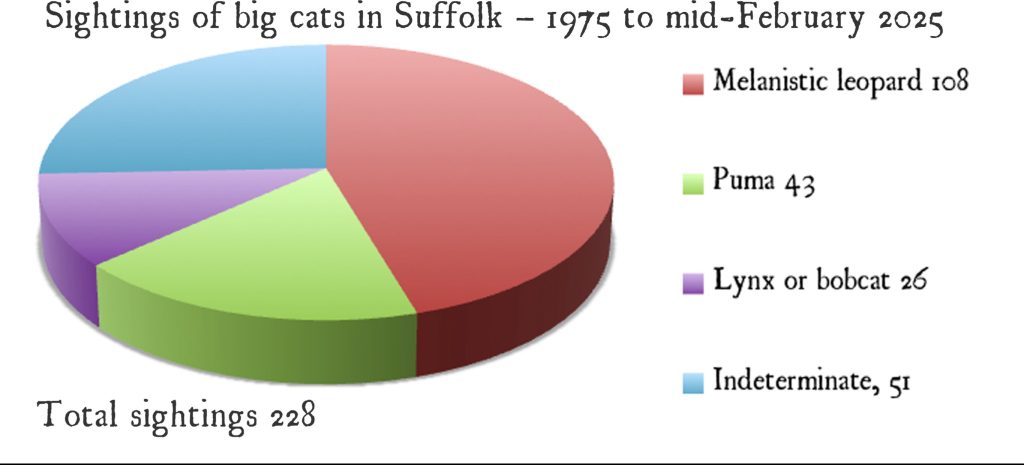
Ecologist and big cat expert Rick Minter tells me the proportions of black leopards, pumas and lynxes reported to me in Suffolk is about the same as most “county samples” of data collected by those monitoring big cats in other parts of Britain. (In any given year, the proportion of pumas or lynxes in Suffolk may be bigger than you’d expect. The 51 “indeterminate” big cats would probably turn out to be either black leopards, pumas, or possibly absolutely enormous feral domestic cats – see below.)
Back in the mid-2010s when I started collecting reports, the witnesses were almost exclusively male – the precarious economy of Suffolk means they were out and about very early in the morning or at night for work in “male occupations” – driving taxis, working in nature management or as delivery drivers and so on. Now the witnesses are almost exclusively female, out walking the dogs or driving.
Roughly half the reports I get are “historic” reports – people contact me to tell me they saw a big cat a few years ago, or ten years ago, or even longer ago. It turns out there are historic waves of big cat sightings in the county of Suffolk that I only found out about years later as more reports from that time came in.
Days spent in the British Library’s Newsroom in London’s St Pancras and in the Suffolk Archive in Ipswich and (back in the day) Lowestoft have uncovered two forgotten waves of big cat sightings. There were multiple sightings of a black big cat around Elveden and the nearby RAF Honington airbase and in the area around Thetford and Bury St Edmunds way back in April 1985. And in 1997 around Wrentham (it’s not far from the coast, between Southwold and Lowestoft), the local police operating out of Southwold Police Station were advising farmers who were organising “lynx patrols” after multiple sightings of a lynx-like cat.
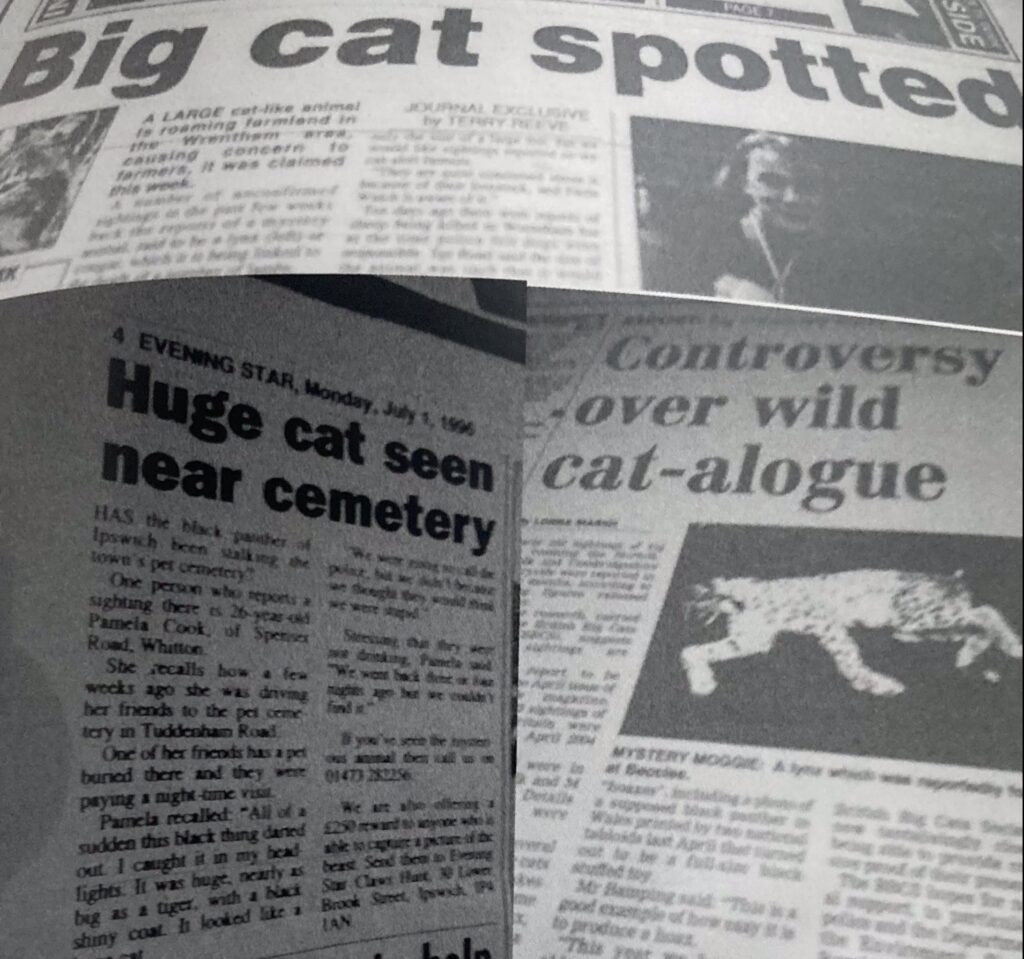
Other Suffolk big cat waves include a countywide spike in big cat sightings in 2007 and again in 2012, while data suggests 2020 was also a busy year for Suffolk big cat sightings. Between 2010 and 2012 there was “The Haverhill Puma” – a “puma or lynx” seen by numerous motorists around the Steeple Bumpstead Roundabout on a trading estate on the edge of the Suffolk town of Haverhill (on the Cambrigeshire border).
There was also “Claws” – the black big cat seen in Ipswich in the 1990s, its name was a lame joke on the film Jaws. The £250 reward in 1990s money for a photo of “Claws” offered by the Ipswich Evening Star newspaper remains unclaimed. Yes, Ipswich is a big town but it’s quite common to see deer in the town’s parks so urban big cats passing through Suffolk’s county town would have enough to eat, and in order to have sightings you need people to see the animals, which is why a comparatively high proportion of Suffolk’s big cat sightings come from its more densely populated areas. I was still getting reports of sightings in Ipswich’s parks last September.
There was a wave of sightings of a slightly smaller than usual black leopard around the West Suffolk city of Bury St Edmunds in the autumn of 2024, and it seems we are in the middle of a wave of big cat sightings around the Suffolk villages of Wickham Market and Easton right now.
There is much variation in sightings, but if there is such a thing as a “typical” Suffolk big cat sighting, it will be a muscular, long-bodied, shiny black animal with short, rounded ears and a long tail – the tail is often as long as the body of the animal, and the tail curves down at the end. Such animals are usually seen for a few seconds crossing the road ahead of the witness – either at night, viewed in headlights, or very early in the morning. These descriptions fit quite closely with that of a black leopard.
In a very small number of cases, the witness gets a good enough view of the animal to see the darker “rosettes” of a leopard’s spots showing up on a background of a slightly lighter shade of black or very dark brown. One example of this was just outside the perimeter of a free range poultry farm near Eye in North Suffolk, where a farmer saw a muscular black big cat with visible rosettes sunning itself on the grass through his rifle sight. (Most farmers round there have a permit for a rifle and a shotgun licence, I’ve spoken to several gun owners who’ve seen big cats through rifle sights including night sights but were so impressed by the animal that they couldn’t bring themselves to shoot it.)
Last year I received a report of a melanistic leopard cub seen by the side of the road at Ixworth, moving clumsily. It was nibbling on a rabbit carcass. As leopard cubs take a long time to learn to hunt for themselves, it’s likely its mother had left out the rabbit carcass for it and was nearby.
Yes, there are some photos of a few Suffolk big cats and some footage. I’ve attached some of these to this article with links to the footage.
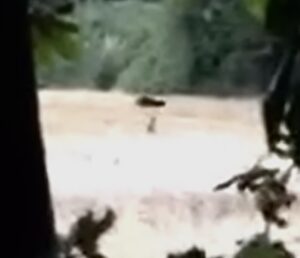
There is footage of a muscular big cat like a black leopard in Wortham, North Suffolk, near the border with Norfolk, from 2010. (Video linked from here.) There is footage of an odd-looking, long thin animal, possibly a light-coloured puma, in a field on the edge of the Norfolk end of the huge Thetford Forest, England’s biggest lowland forest that straddles the Norfolk-Suffolk border. Its strange off-white colour may be a trick of the spectacular evening light just before sunset you get in the East of England, where breath-taking pink, gold or fiery red sunsets are common. (Video linked from here.)
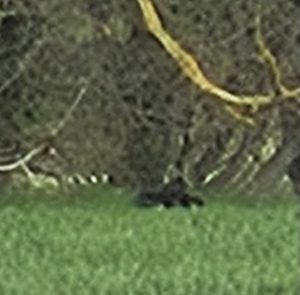
There is a series of blurry photos of something very big and black lying on the edge of woodland near Eye. The most wafer-thin of celebrity connections (it’s not far from Ed Sheeran’s estate in Dennington) meant that it got on the front page of the Daily Star and the Mail and got me interviewed on Channel Five News. I’ve recently been sent some interesting footage from the village of Darsham, not far from the coast and near where I am based, showing something that looks big and black moving through a freshly harvested field. I hope to visit the location and do some measuring of distances shortly.
Recently I’ve got a lot of rather grisly photos of big cat kill signs – several species of deer, a swan, a lamb and the spine of a “yearling muntjac” which according to an expert was eaten by something the size of a wildcat or bigger, but not by anything puma or leopard-sized – I am told a puma or leopard would have easily swallowed the spine whole.
Most of these stomach-churning photos of likely big cat kills come from the area around Wickham Market, which is right now in the middle of a wave of sightings of a something like a black leopard. I’ve talked to rangers on nature reserves who told me they found the corpses of red deer that show clear signs of predation by a big cat. I’m now in touch with a network of deerstalkers and other wildlife people who are ready to get DNA samples as quickly as possible to a friendly university laboratory next time they find any deer or other livestock that show big cat kill signs.
Some of the big cats reported to me don’t fit the descriptions of any known big cats. There’s a description of a long-legged, slim black big cat with “tufted ears” seen on Ufford golf course in 2009. There was also a very heavily built animal that looked like a black lynx seen near a roundabout in Thetford Forest in September 2021 (There are black lynxes but they are very rare.)
Odder still was the big cat seen from the road near Spexhall, just outside the town of Halesworth on Stone Street, the old straight Roman road (the A144) heading north to the town of Beccles, back in 1997. Its witnesses described it as “dirty brown, its colour showed up clearly against the background of the green corn. Its head had what I first thought were two small pointed “horns” that stood straight up on its head. Body was thick set and shaped like a cat underneath but its tail was most striking; it was long, hung straight down and curved up at the bottom.” It was “about the size of a large deer, quite long and catlike, but I couldn’t specify the length.” If it was a lynx or caracal it was an absolutely enormous and very unusual one.
As well as the black leopards, pumas and lynxes out there (we’ll come to lynxes and pumas shortly) there also seems to be something like a huge feral domestic cat out there in Suffolk. Two young anglers at Falcon Meadow, by the river at Bungay, in 2004 encountered a black big cat that had “a head like a housecat but five times the size” . Another animal, seen by three young men walking on a moonlit night from Ipswich to Claydon, saw a cat that was leopard-sized but with a tapered, pointy tail like a domestic cat’s.
Brenda Sore of the village of Peasenhall saw a black big cat by the local transformer station and described it to me over the phone, her description was that of a black leopard, except that it had pointed ears. But Jonathan McGowan’s recent The British Big Cat Phenomenon series of books (Hanger 1 Publishing, North Haven 2022) confirms that some individual leopards can have more pointed ears.
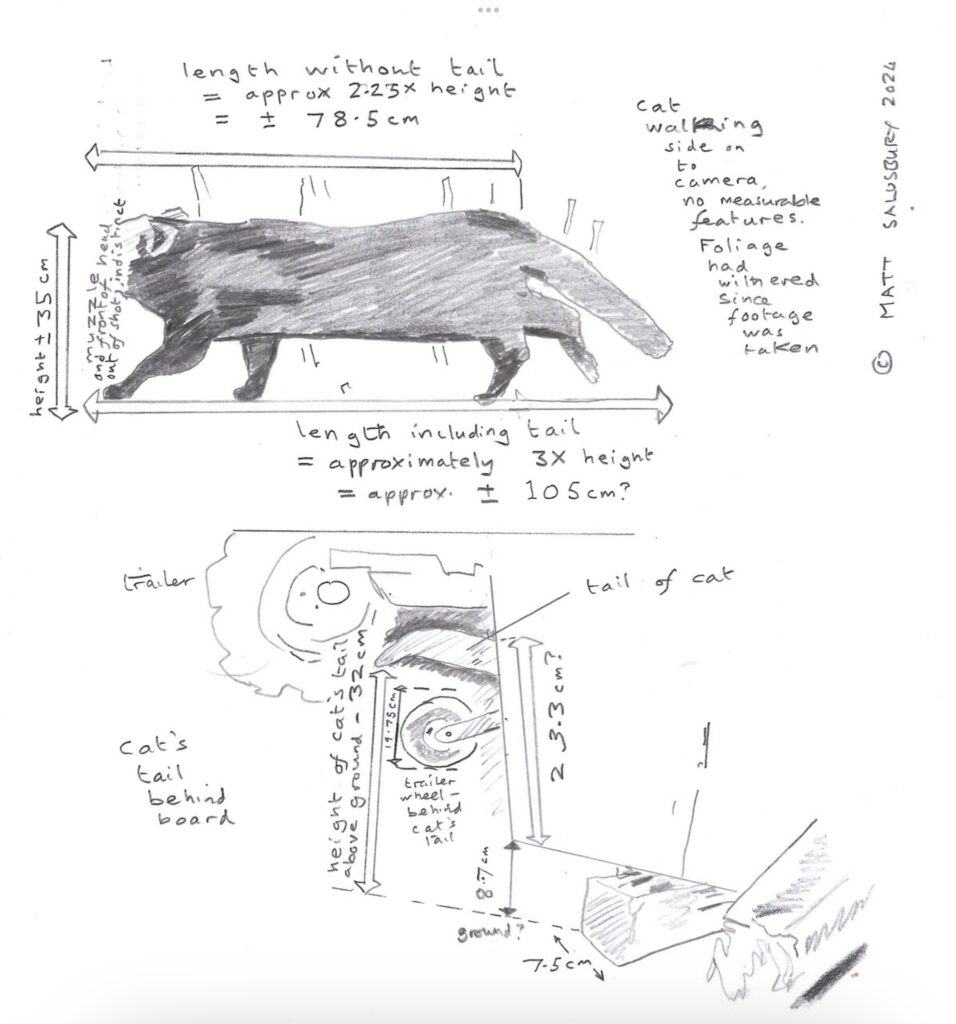
More recently, I’ve had several reports of something like a very large domestic cat in the area around Brightwell, between Ipswich and Woodbridge. A witness filmed it on trail cams, I can’t share the still photos here but I have included some drawings based on the photos. Its body is just under a metre long – not a record-breakingly big domestic cat but still a very large one. The witness describes something at around the same time that was caught in a humane fox trap and that was strong enough to bend the bars and escape. Another witness described to me seeing in 2022 on the Lymballs’ Lane road through the forest towards Dunwich, a “large old cat, walking as if elderly, like a huge feral… a strange stony grey colour… slightly smaller than a muntjac.”
When I first started monitoring big cats locally there was a steady trickle of reports of pumas (also known as mountain lions or cougars) as well as black leopards. These Suffolk pumas vary in colour from a “golden puma” seen around West Stow in the King’s Forest in the 2010s, to a “grey puma” logged in Babergh (South Suffolk, Gainsborough Country and Constable Country, where they filmed Lovejoy) in a 2014 Suffolk Police report. More recent puma sightings describe a “tan” animal. A tan puma was encountered by a US Air Force ground crewman in 2011 near RAF Lakenheath where he worked, it fought briefly with his staffie dog.
Then pumas suddenly disappeared from Suffolk around 2018, with only the very occasional sighting just over the Cambridgeshire border near West Suffolk. Then pumas popped up again in 2020, in Rougham near Bury St Edmunds, then in Rendham near Saxmundham in 2023, then on the Sutton Hoo Estate a “tan cat” that was puma-sized was seen in 2024.There was a “light coloured cat” seen at a housing estate on the edge of Bury St Edmunds in the early days of 2025. This summer there was a report from Gedding, near the Bradfield Woods nature reserve, of a “massive, massive cat”, tan coloured, with “massive long tail”, which ran across the road ten feet (three metres) ahead of the driver who saw it.
There are occasional sightings of lynxes or bobcats in Suffolk too. (Bobcats are slightly smaller than lynxes and closely related.) These go all the way back to 1995 when two young men “wild camping” early one morning at Staverton Thicks on the edge of Rendlesham Forest, got a good look at a couple of “lynxes or bobcats.” There was the above-mentioned wave of lynx sightings and the farmers’ anti-lynx patrols in the same year around Wrentham. I’ve heard of more lynx sightings in recent years, with a lot of such reports from “the peninsulas”, the (even by Suffolk standards) remote Bawdsey Peninsula and Shotley Peninsula south of Ipswich and the shores of the River Orwell round there. A customs officer on duty one night, looking out to sea at Reydon Cliffs, just North of Southwold in 2005 with infra-red binoculars, turned round the face inland and saw a lynx “washing itself.”
Captive lynxes and bobcats escaped from captivity in East Anglia are well documented. An escaped lynx was shot in Great Witchingham, Norfolk in 1992 while my Freedom of Information Act request to West Suffolk Council uncovered details of a bobcat that escaped from its carrier while being loaded into a vehicle to be rehomed during the Covid lockdown of 2020. It was shot and injured by a farmer whose chickens it had been helping itself to, then rescued by the RSPCA, taken to a vet for treatment and rehomed. The correspondence between West Suffolk and the unnamed owner revealed that there are a lot more licensed exotic wildcats being kept in captivity in the county than people would expect. At Santon Downham on the edge of Thetford Forest in the noughties, locals used to regularly hear lynx-like screams and “everyone knew” that “the lynx man” kept lynxes in an enclosure somewhere nearby.
Another recent phenomenon in big cat reports is the “growling” of big cats being heard, described by one witness as “like a large heavy object being dragged across a concrete floor”, or the distinctive “sawing” noise of a leopard. Such growling has been reported in recent years in Chillesford near Sudbury in the South of the county, also near the town of Woodbridge (one of the people who heard it was a professional musician with a “good ear”), also in Redgrave and Lopham Fen on the Norfolk border. Most recently, an informant near Wickham Market described a noise like cats fighting but much, much louder.
Reports of big cat vocalisations heard in Suffolk go back a long way – one witness who lived a short distance from the Africa Alive! Wildlife park in Kessingland (it’s near Lowestoft) would every morning hear the calls of the serval African wildcats kept there. But one morning in 2006 he heard the usual serval calls, followed by “exactly the same sound coming from the opposite direction”!
However, whenever I’ve had recordings of the noises said to be made by a big cat I’ve run these past deerstalkers or had experts analyse the soundwaves compared to the known calls of various animals. In all such cases it turns out to be the bellowing of a rutting red deer.
As I write, a project with trail cams has started along the Waveney River around the town of Bungay and another project with trail cams is starting in the Bawdsey Peninsula near Felixstowe Ferry. The latter will include microphones to record animal sounds, using AI to filter out anything of interest.
©️ Matt Salusbury 2025