


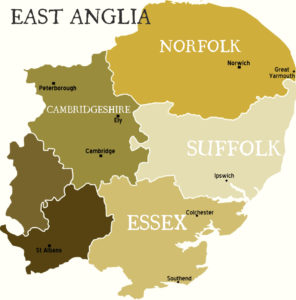
East Anglia, where’s that, then? Good question!
East Anglia is generally assumed to be the East of England counties of Essex, Suffolk and Norfolk. (The East Anglian Daily Times newspaper, for example, covers North Essex, Suffolk and South Norfolk.)
But it depends who you ask, other organisations regard East Anglia as being Suffolk, Norfolk and Cambridgeshire, usually also including the autonomous Peterborough Unitary Authority on the edge of Cambridgeshire. This version of East Anglia – the one with Cambridgeshire in it – usually leaves out Essex.
So East Anglia is a bit of a moveable feast. For a lengthy explanation, see “Jade Goody and the many faces of East Anglia,” by Lawrence Cawley, BBC News, 15 May 2016.
The Anglo-Saxon Kingdom of East Anglia flourished from the late fifth century to the ninth century AD. It covered present day Norfolk and Suffolk, some of present day North Essex and considerable parts of modern Cambridgeshire. Within the Kingdom of East Anglia, there were two shires – Norfolk (the “North Folk”) and Suffolk (the “South Folk”.)
While this website is principally concerned with big cat sightings in the county of Suffolk, big cats are no respecters of county boundaries and frequently cross in and out of Suffolk and its neighbouring counties of Norfolk, Cambridgeshire and Essex. Some of the most active regions of Suffolk for big cat activity are on its northern border with Norfolk and its eastern border with Cambridgeshire. For this reason, bigcatsofsuffolk.com also documents sightings of big cats in East Anglia – whether Essex, Norfolk or Cambridgeshire.
I regularly receive reports of sightings from these counties, particularly Norfolk. From their descriptions, some of the big cats reported in Suffolk and in Norfolk, Cambridgeshire and Essex (often immediately before or soon after their reported appearance in Suffolk) sound like they are the same individuals on the move.
To confuse matters still further, there also the “East of England“. This is a region beloved of development agencies, investment initiatives, local government partnerships, an All Party Parliamentary Group and such. There’s a “BBC East” entity, whose radio show I’ve been on talking about big cats. This region has recently become known as “the Eastern Powerhouse.”
The East of England is generally considered to include all of the counties of the widely-defined East Anglia (Suffolk, Norfolk, Essex, Cambridgeshire, Peterborough Unitary Authority) and South Lincolnshire, Bedfordshire and Hertfordshire as well. I was delighted to find a leaflet for Dutch tourists on the Stena Line ferry from Hoek van Holland to Harwich a few years ago that said, “Welkommen naar het Oost van Engeland.” (Welcome to the East of England.)
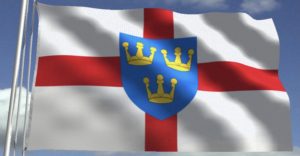
The flag of East Anglia. Other versions of the East Anglian flag also include the crossed arrows and crown of St Edmund the Martyr, King of East Anglia, which also features on the Suffolk flag.
