Latin Names for Big Cats

Display with many of the big cats and some species of wildcat at the Zoology Museum, Kaunas. From left to right, top row: spotted leopard, cheetah, cheetah cub, spotted leopard. Top row of case in the centre: jungle cat, (seated), ocelot, badly stuffed caracal, snow leopard, next row down: deteriorating specimen of a serval and cubs, Pallas cat, bottom row: tigers and cubs.

No lions, tigers, cheetahs or snow leopards living in the wild in Britain
The big cats reported as seen in the wild in East Anglia – and in Britain generally – are mostly black leopards, pumas and lynxes and a smaller number of various species of exotic wildcats. Some are described as enormous feral domestic cats. There are no credible reports of lions, tigers or cheetahs in the wild in the UK.

While leopards, pumas and lynxes are mostly solitary hunters are home in creatures of forest, heath, jungle, undergrowth, woodland or even in deserts or towns, lions (Panthera leo) hunt in packs and need open plains or savannah. They are not adapted to the British countryside and probably wouldn’t survive there – they aren’t able to stay hidden long enough.

Sadly, on occasions when lions have escaped from captivity, they have been recaptured or – usually – shot dead within 48 hours. A lion escaped and was quickly short dead somewhere in Norfolk on 6 January 1984, a day after it escaped, according to data released by Defra. It is believed to have escaped from a no longer extant wildlife park or zoo in Cromer.

There are Suffolk mystery cats that have been named as “lions”. There was the “Debenham Lion”, seen around that village in 1986. It probably got that name because of the Debenham Lion pub, which closed down at around that time. From its description, the Debenham Lion mystery cat may have been a misidentified Maine Coon cat – they were a new and easily misidentified phenomenon in Britain in those days. There was also the “Darsham Lion” described as like a “lioness” sunning itself by the A12 at Darsham very early one morning in 2003. Then there was the ” Ling Lioness” at the Wortham Ling nature reserve on the Norfolk-Suffolk border. She probably got that name because it was alliterative. Both the Darsham Lion and the Ling Lioness and other East Anglian big cats reported as being a “lioness” or “female lion”  were mostly likely pumas.

Tigers, (Panthera tigris) the biggest of the big cats, would also have a hard time surviving and staying hidden in the British countryside. They’d have trouble finding enough to eat there. I had to go back to 1983 to find an example of a British tiger escape, from Knaresborough Zoo. It was very quickly shot dead by police.  (See a list of British captive big cat escapes, recaptures and shootings here.) Reports of tigers in the wild the UK are seldom credible and are often vague – for example, the animal reported to Norfolk Police seen in Attleborough, Norfolk in 2008, as “what looked like a lion or tiger walking in the road.” Lions and tigers are, of course, very different-looking animals.

There have been a few cases of tiger sightings in Suffolk, but these have quickly turned out to be misidentified large realistic dumped soft toys. (Siam Gardens, Sudbury in February 2012 and Trimley St Martin in April 2013, for example.)

East Anglia’s ‘fen tiger” – not an actual tiger
Confusingly, there is a local mystery big cat known as the  fen tiger”, reported – and photographed – mostly in Cambridgeshire and the northwestern corner of Suffolk since 1974. But the “fen tiger” looks nothing like a tiger and is described as a skinny, wiry, long-legged “black panther”  or even as resembling a “puma or lynx.” The big cat known as the “fen tiger” is called  a tiger because it’s named after a regional type of person. I said it was confusing!

The term “fen tigers” originally appears to have been originally been coined to describe the human inhabitants of the fens – the extensive marshland in the region of Cambridgeshire and West Suffolk that was eventually reclaimed for farmland. Engineers worked to reclaim the fens, but for three hundred years, the people of the fens resisted with extraordinary hostility any attempts by the engineers to drain the land and replace the hand-to-mouth existence that was their ancient way of life with agriculture. The fen people feared – rightly – they would lose their ancient rights to shoot gamebirds and other privileges, and the agriculturalists had their eye on the fenland because, once drained, it was some of the most fertile land in the country. It was this fierce hostility that earned the fen folk the name “the fen tigers”.  When a mystery big cat appeared, it wasn’t long before the legendary local term “fen tiger” was applied to it. The local Speedway team chose the name  Mildenhall Fen Tigers for the same reason.

The “fen tiger” is also known – less confusingly – as the Beast of Balsham, after the village on the Cambridgeshire-Suffolk border where it has been sighted. (See also Mystery Animals of Suffolk, Chapter 17)

No East Anglian snow leopards either
While there are a surprising number of snow leopards (Panthera uncia) in captivity in the UK, according to Dangerous Wild Animals Act Licensing data released by local councils, I’ve heard of only two reports of snow leopards in the wild in the UK, Both of these were clearly recent escapes and neither were in East Anglia.

One of the earliest mystery big cats was the “Shooter’s Hill Cheetah seen around southeast London in 1963. But I’m not aware of any British cheetah sightings since then. And captive cheetahs are remarkably tame, which means their chances of survival in the wild wouldn’t be great. When Akea the  cheetah escaped from Hamerton Zoo in Cambridgeshire in 2008, he wandered into a neighbour’s garden where zookeepers arrived, put a collar round his neck and waited for the cage truck to arrive.

While there appear to be no lions, tigers or snow leopards living in the wild in East Anglia, you can still see some in that region. Jimmy’s Farm near Ipswich has an Amur tiger and an Asiatic lion.

Africa Alive! in Kessingland  in Suffolk has African lions, cheetahs and servals. Shepreth Wildife Park in Cambridgeshire has  and Sumatran tigers and Scottish wildcats as well. Linton Zoo in Cambridgeshire has lions, tigers and snow leopards Johnson’s of Old Hurst Zoo in Cambridgeshire has lions, as well as pumas and ocelots.
 

Oddities and Hybrids

Some of the British big cats reported from Suffolk and elsewhere don’t match the description of any known species of big cat or wildcat. Some of these may be hybrids of different species of feline, or even hybrids of exotic wildcats and feral domestic cats. Such hybrids  have been recorded in captivity and in the wild.

Mystery Animals of Suffolk looks at possible hybrid big cats. See also Hybrid Felines on the Messy Beast website.


Gigantic Feral Domestic Cats

I’ve heard a lot about Bengal cats, and how Britain’s big cats are supposed to be misidentified Bengal cats, how the genes of Bengal cats and other exotic breeds are supposed to have got into the feral cat population and turned them into something altogether different… and bigger. I heard that Bengal cats were real characters, they liked to go for walks on leads, and that they were such a handful behaviourally that they were often abandoned. I recall reading Big Cat Rescue saying that they used to get call-outs from people saying there was a “Florida panther” on the loose, attacking Alsatians and in some cases frightening old ladies, but when they got there it was often just an ever so slightly bigger than usual Bengal cat that had gone AWOL or been turned loose.

Legends tell of how the original Bengal cats, hybrids of the Asian leopard cat (Prionailurus bengalensis bengalensis) were named after one that was found in the Bay of Bengal on the approaches to Bombay (Mumbai) by early East India Company sailors, swimming out towards them. Like most exotic stories on the origins of exotic cat breeds, it’s probably nonsense. (Burmese cats weren’t originally from Burma, but from Thailand, “Bombay” cats were bred in Virginia, and so on.) We know they were deliberately crossbred. The UK Dangerous Wild Animals Act 1976 came in largely because Bengal cats (and wolf dogs, crosses between dogs and wolves) were turning up in the country, with the authorities unsure how they would turn out, the law banned wolfdogs (they’re now legal) and required a license for Bengal cats that had more leopard cat genes than “F4” (fourth generation). Bengal cats are known for their “confident” temperament (a bit of an understatement!) Breeders sell them for anything up to £800 each.

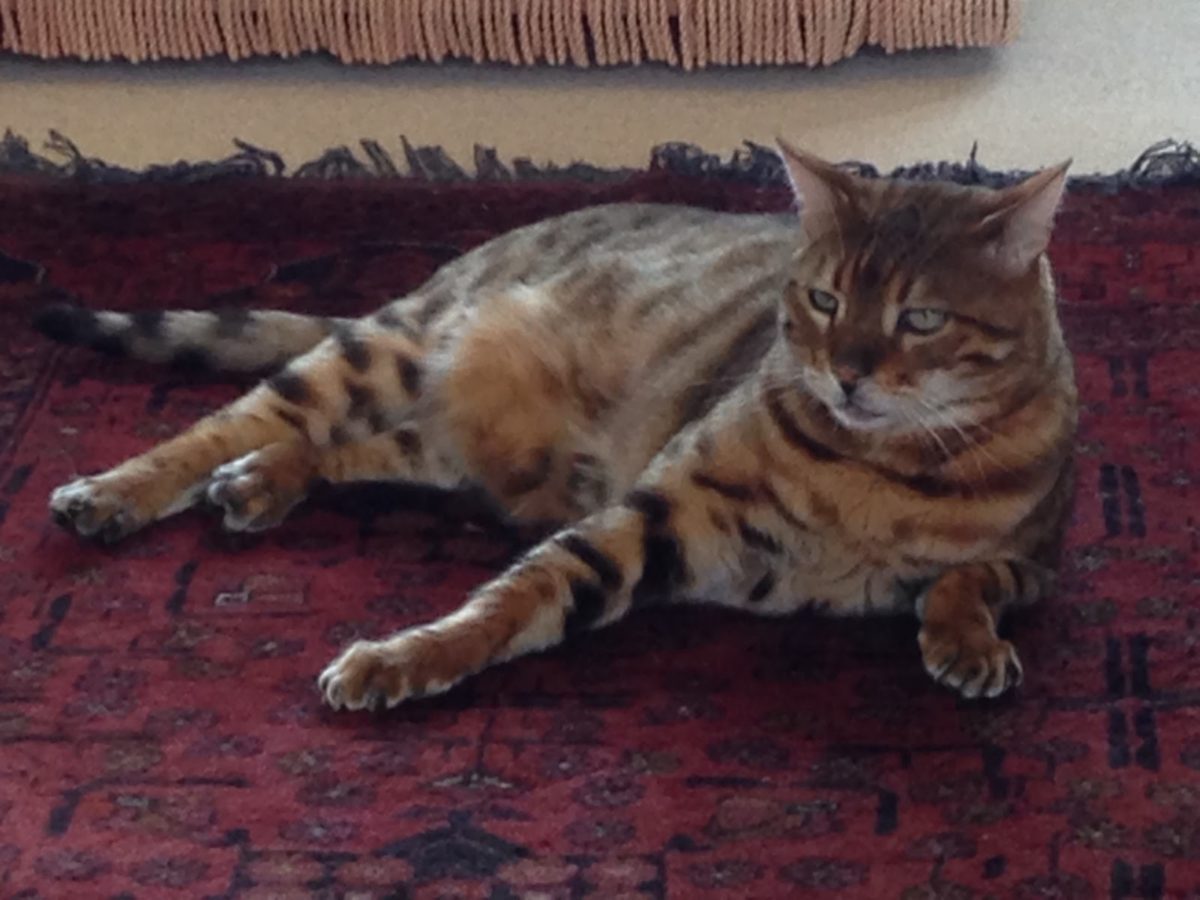
I finally got to meet a Bengal cat face to face. He lives somewhere in the Blyth Valley in Suffolk, looked after by a fosterer. He came from a smaller house at the other end of the same village, but he obviously decided he didn’t like his accommodation and fancied living in a bigger house and garden nearby, so he abandoned his humans and moved on in his new chosen home – fairly typical Bengal cat behaviour, I am told!

He is very vocal, quite friendly, and the two things that really struck me about him are that he is very muscular – at first glance he looks a little on the overweight side until you see that he is all muscle. Secondly, his fur is very short and shiny, it has a different feel to most cat fur. His back is also different to a mainstream domestic cats – a bit more arched. His toes seem a little longer too. The vestigal pad that most cats have towards the back of their paws is much more pronounced.

And check out his markings – quite unlike anything you’d see on a domestic cat – those leopard-like rosettes!

Exotic Wildcats

The term “wildcats” includes many species of felines that are different from the domestic cat Felis cattus.

There is a European wildcat Felis sylvestris. Within Britain, the native European wildcat – the Scottish wildcat – is now confined to enclaves within Scotland, where numbers are slowly recovering. There have been reports of something like a Scottish wildcat in other parts of the UK – I have heard one from Suffolk. Obviously, it’s hard to tell a Scottish wildcat from a conventional tabby feral domestic cat.

Jonathan McGowan, who has been investigating big cats in Dorset for decades, found a dead European wildcat kitten in a forest there.

Other wildcat species of which sightings are reported in Britain include servals, caracals and  jungle cats.

Black leopards


AFTER LIONS and tigers, leopards are the biggest of the big cats. I regularly receive reports of black big cats the size of a large Labrador, plus a long tail, which is about leopard- sized.

Leopards have one of the most extensive  geographical distributions of any wild mammal, being found across Africa and Asia including the Middle East and all the way to Indonesia. They are “generalists” – very adaptable indeed, thriving in a variety of environments including arid hills, rainforests and jungles, even towns, and their habitats include much colder places than the British Isles. 

This suggests leopards would have no trouble adapting to life in the British Isles. In some regions of some countries – India and Indonesia, for example, much of the leopard’s diet is muntjac deer (or their close relatives). Muntjac deer are now found in abundance in East Anglia.

The vast majority of big cat sightings in Suffolk – and in Britain – see to be of melanistic leopards – at least two thirds of any “county sample” of big cats seen in a given area are black leopards.

Leopards (Panthera pardus) frequently carry their prey up trees to eat in peace or to stash their to come back and eats bits of it later, so any remains of deer up a tree found in Suffolk are likely to have been put there by a leopard. They are generally solitary and warn each other of their presence with a “sawing” roar, rasping sounds or a noise like a cough.

Leopards also leave scent-marks to mark their territory and also leave scratch marks on trees.

For some unknown reason, nearly all the leopards reported seen in the wild in the British Isles are melanistic – black leopards. I have heard of spotted leopards seen on the South Coast of England – around Dorset – and I have been shown the yellow and black hairs of a leopard left on barbed wire in the Purbeck Reedbeds round there.

I have also heard a report of a leopard seen in Essex, in the area around Epping Forest, that was spotted at the front and up to halfway up its body and black on the back half. The Beast of Brookland, a big cat seen in Essex around 2018, is described by witnesses as a spotted leopard.


Leopard wool from a spotted leopard, pulled off a barbed wire fence in the Purbeck Reed Beds, Dorset back in 2013, with thanks to Jonathan  McGowan. Photo by the author.

Different populations  of leopards around the world have a different frequencies of melanistic individuals occurring within them. Black leopards seem to be generally much rarer in Africa than in Asia, with the exception of the Abardare Highlands  in Kenya, where black leopards are relatively common.  Within Asia , some populations have many more black leopards than others – Malaysia and Indonesia are believed to have the highest proportion of melanistic leopards. (See below.)

At the time of writing you can see a black leopard in East Anglia. Lela the melanistic leopard lives at Hamerton Zoo in Cambridgeshire.  Hamerton Zoo also has servals, tigers including white tigers, Canadian lynxes, oncillas and rusty spotted cats.

One witness who got a good look at a Suffolk big cat through a rifle sight (no, he didn’t shoot) was able to see that the animal, which was sunning itself, was shiny black with visible spots and rosettes in a slightly darker hue. This was likely a melanistic (black) leopard. Several reports I have received describe a very, very dark brown animal. While dark chocolate brown pumas do exist, this is more likely to be a melanistic leopard which is a near-black very dark shade of brown. Some black felids have a more rusty brown coat in the summer.

Melanistic leopards are sometimes informally known as “black panthers”. Technically, however, there is no such animal as a “panther”. Zoology recognises leopards and pumas. Leopards are sometimes called “panthers”, especially “black panthers”, while The Pink Panther from the films and cartoons was probably supposed to be a leopard. Confusingly, pumas are also referred to as “panthers”, especially the “Eastern panthers” of southern Florida and the officially locally extinct but still reported panthers of eastern seaboard of the USA and Canada.


Some not particularly well stuffed leopard specimens at the Tadas Ivanauskas Zoological Museum in Kaunas, Lithuania. There is a lot of variation in just how black melanistic leopards are – from pure jet black to dark brown with clearly visible darker rosettes. These specimens could date back to as early as the 1920s and the black colour in melanistic taxidermy specimens tend to fade over the years.

There are at least eight known sub-species of leopard. (Possibly more, depending on who you ask.) Any leopards living in the wild in Britain are likely to be a mix of several different sub-species and populations.

The African leopard  (Panthera pardus pardus) has a range mostly in Sub-Saharan Africa but also some isolated populations in the north of the continent.

Within all leopard subspecies, including the African leopard,  there are a lot of variations in local – now usually isolated – populations.  African leopards in parts of the Congo DR, for example, are more massive and muscular, while Somali  “micro-leopards” are among the smallest of all leopards, not that much bigger than some species of lynx or wildcat. The African leopards of the Cape Provinces at the southern tip of South Africa are also said to be smaller. The (spotted) leopards of Africa are generally bigger than Asian leopards.

Arabian leopards (Panthera pardus nmir) are critically endangered, with fewer than a hundred animals left in the wild. They are now thought to be restricted to arid, mountainous regions in Oman, Yemen and possibly Saudi Arabia.

Indian leopards  (Panthera pardus fusca) are said to have  larger rosettes than the other subspecies, with a paler coat in desert habitats, greyer coats in colder climes and more ochre in rainforest habitats. Some of them now live in towns, very close to humans.

The Persian leopard   also known as the Anatolian leopard  (Panthera pardus saxicolor also known as  Panthera pardus tulliana) is found across Iran and Afghanistan, the Caucuses and (probably) Turkmenistan. It is regarded as one of the bigger subspecies of leopard in the world. It has relatively few spots and rounded ears. (Some sources list the Persian leopard and the Anatolian leopard as different sub-species, other sources lump them together.)

Indochinese leopards (Panthera pardus delacouri) are found in Southeast Asia – most of them are to be found on the Thai-Malaysian border and eastern Cambodia and also in southern China. They hunt mostly at night and have short fur and if they are spotted have short fur and almost rusty-red colouration. Spotted Indochinese leopards has  small rosettes, often so close together that its fur looks dark.

Camera trap studies from 1996 to 2008 in southern Thailand and the Malaysian peninsula showed that north of the narrow Kra Isthmus in southern Thailand and Myanmar, Indochinese leopards are predominantly spotted, south of this isthmus they are nearly all black. It is thought that black colouration confers an advantage in ambushes in this environment. The mostly black leopard population south of the Kra Isthmus is threatened by hunting – there are now thought to be as few as 500 such leopards left in the wild.

There is also the Javan leopard   (Panthera pardus melas) now restricted to the western end of the Indonesian island of Java. It hunts in the day and has a greater population density than Indochinese leopards. It is smaller than mainland leopards with a darker coat and spots spaced closely together. It is estimated that around a third of Javan leopards are melanistic.

The Amur leopard     (Panthera pardus orientalis) is currently  now critically endangered, down to maybe 100 individuals in the wild in the Russian Far East and the Russian-Chinese border. They are now more numerous in zoos than in the wild.  They are relatively small and have cream coloured fur that is more rusty red in the winter, when it is much thicker. They are quite diurnal (hunting in the day). Within East Anglia, Thrigby Hall wildlife park in Norfolk has a spotted Amur leopards – as does Colchester Zoo in Essex, which additionally has an Amur tiger, an African lion and a cheetah.

The Sri Lankan leopard (Panthera pardus kotiya) is a quite large sub-species with a rusty yellow colour with dark spots and close-set rosettes. Within East Anglia, Banham Zoo  in Norfolk has a spotted Sri Lankan leopard – it also has a margay, an Amur tiger, a cheetah, a snow leopard and a Pallas cat.

There’s an identification chart comparing different subspecies of leopard here (scroll to p5.)

Leopards share with pumas the characteristic of having a long tail which in many cases bends down and then bends up again near the end. The end of the tail is blunt (usually with a black tip in the case of spotted leopards) and a little bushy. It is this downward and then upward pointing tail that distinguishes leopards and pumas from any possible huge feral domestic cats.

There are also occasional “mutant leopards” encountered – unusual and atypical leopards with unusual colouration including melanistic leopards, albinos, “blue”, grey, “strawberry”, white-footed and short-tailed leopards.

There are unconfirmed rumours that black leopards were cross-bred with black jaguars to “fix” the melanistic black gene by breeders in the 1970s. A few black big cats that have been reported to me are massive and muscular with short necks and massive, round heads in a way that could be accounted for if they have a bit of jaguar inheritance in them. For more on hybrids between leopards and jaguars and between leopards and other species of big cat see here

Leopards have been recorded as living around 10-15 years in the wild. So if the black big cats reported in Suffolk are black leopards that were let loose in the mid-1970s, they would now be in theirs fourth of fight generation.

Clouded leopards (Neofelis nebulosa), snow leopards (Panthera uncia) and leopard cats (Prionailurus bengalensis) – despite their English names – are not species of leopard and none of these animals are closely related to leopards. While some of these species are kept in captivity in the region, nothing answering the description of a snow leopard, clouded leopard or leopard cat has been reported in the wild in East Anglia.


Another taxidermy spotted leopard at Tadas Ivanauskas Zoological Museum, Lithuania.